
There's No Crying in Robotaxi: Why Human Rideshare Cannot Compete
For human rideshare drivers, the 'dead-ender' trips — long, unpaid return journeys — represent a massive hidden cost. When robotaxis arrive, without a home to get back to, this fundamental economic imbalance will spell the end of human-driven rideshare as we know it.
“There’s no crying in baseball,” Tom Hanks famously barked in A League of Their Own, and I’m here to tell you there’s even less crying in a robotaxi. That’s not a knock on the stoic, mechanical nature of future transportation, but a cold, hard fact about the economic forces that will soon obliterate human-driven rideshare services. Having spent my fair share of hours behind the wheel, staring down long stretches of highway with an empty passenger seat, I can tell you exactly why the model is doomed.
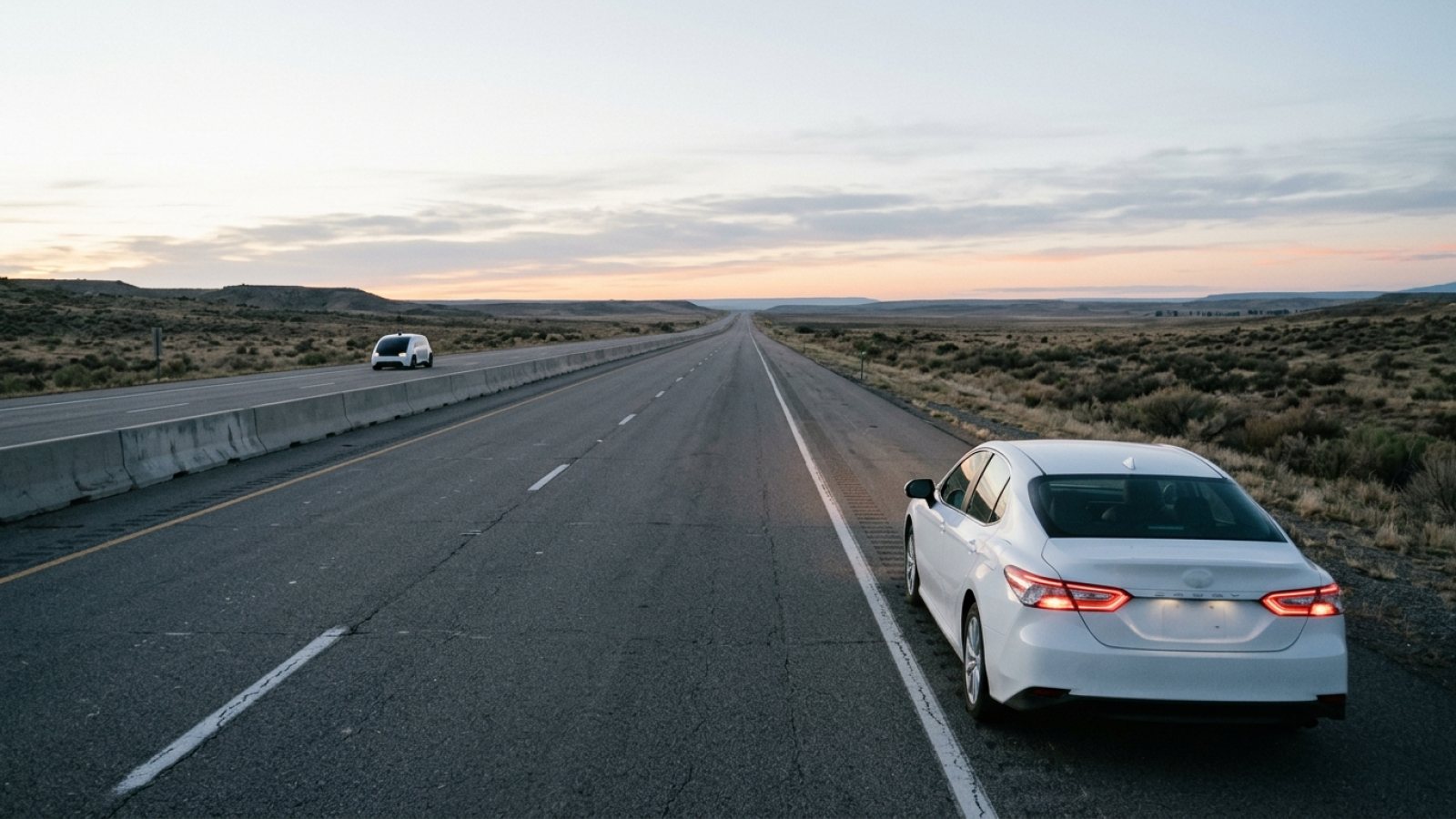
The issue isn't about human connection or a spotless car interior; it's about the invisible, uncompensated costs of the road, particularly the dreaded 'dead-ender' trip. Think of it: a driver takes a passenger from Palm Bay to Orlando. That’s roughly 80 miles, paid. But then, to get back to Palm Bay, or at least a high-demand area, the driver has to embark on another 80 miles – that's approximately 160 miles round trip, with only half of it generating income. Those return miles are a phantom limb for the business model: they consume fuel, wear and tear on the vehicle, and hours of a human's life, all for zero pay. It’s a cost built into the very fabric of human rideshare that a robotaxi fleet simply does not carry.
The Invisible Cost of "Home"
As a Chimp who appreciates the comforts of a well-designed home and a good armchair, I can tell you that the fundamental difference between me (or any human driver) and a robotaxi is the desire to go home. Or, at least, to avoid being stranded hundreds of miles away from a lucrative zone. My car, my fuel, my time – these are finite resources, and every dead-ender trip chips away at the already slim margins. For the human driver, that 80-mile return journey isn’t just an inconvenience; it’s an active drain on profit. It dictates when you stop, where you park, and how long you’re willing to stay out. It means factoring in the psychological cost of being far from your support network, or just a decent coffee shop.
This isn't about blaming the platforms; it's about the inherent structure of the work when a human is involved. We are not perfectly fungible units; we have lives, families, and geographic anchors. The expectation that a driver will absorb these return costs is a hidden subsidy for the entire rideshare ecosystem. It's a button pushed right into the driver's wallet, quietly extracting value while presenting a low headline price to the customer.
The Unblinking Eye of the Robotaxi
Now, consider the robotaxi. Does it have a home? No. Does it care about driving 80 empty miles after dropping off a passenger? Only in the purely economic sense of fuel (or charge) consumption. It doesn't get tired. It doesn't miss its family. It doesn't have a specific parking spot it prefers. It simply receives new instructions. When a human driver is heading back unpaid, a robotaxi is either already on its way to its next paid fare, or repositioning itself optimally for the next passenger, wherever that may be, without the human imperative to return to a personal base.
This is the cold, hard logic that will gut human rideshare. A robotaxi fleet can dramatically reduce the percentage of uncompensated 'dead-head' miles. It can optimize routes, predict demand, and even 'float' in low-demand areas without accruing human wages for waiting. This operational efficiency isn't just a marginal gain; it's a structural advantage so profound that human rideshare, operating with its built-in return journey penalty, will struggle to compete on cost alone. The robot doesn't cry because it has no tears; it has no mortgage and no kids to pick up from school.
More Than Just Miles
Of course, this isn't to say robotaxi fleets are without their own challenges. They incur significant costs in development, maintenance, charging infrastructure, and the regulatory hoops they must jump through to even operate. There are still empty miles for robotaxis too – they need to move for charging, rebalancing, or maintenance. Safety protocols are stringent and expensive, and the public's trust is still being earned, city by city. Coverage remains a patchwork, not a blanket. These are real hurdles, and they will keep human drivers relevant for a while, especially in niche markets or areas where autonomous technology isn't mature or permitted.
However, these are operational challenges that technology and investment can incrementally overcome. The fundamental economic advantage of shedding the human element's 'dead-ender' costs is a game-changer. It’s not about whether robotaxis are perfect, but whether they are economically superior in the aggregate over the long haul. And the answer, unequivocally, is yes. The shift isn't just coming; it's already here, silently pushing on the buttons of an unsustainable model.
So, what does this mean for the future? Human rideshare will become a luxury service, a niche for those who desire conversation or specific, non-standard routes. But for the everyday point-to-point journey, the robotaxi, with its unblinking indifference to the costs of 'home,' will sweep the field. Our verdict is clear: prepare for a future where your next ride is more likely to be a silicon brain than a human face. And if you’re a driver, it’s time to start planning your next move, because this particular game is about to end.
