
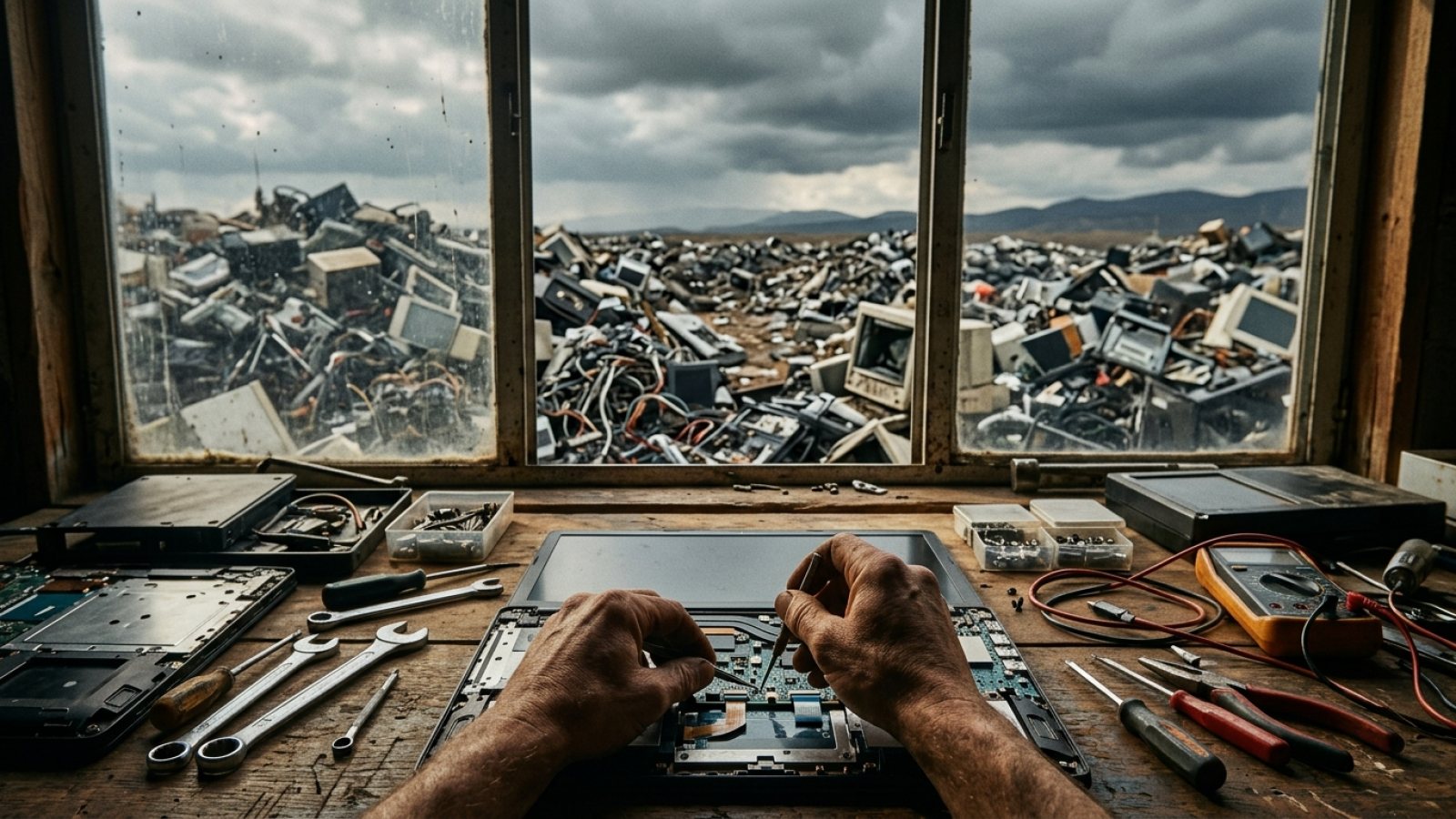
The Screwdriver Test: Why the Right to Repair is About Ownership, Not Just Spanners
We've been convinced that owning something means we just get to look at it, not fix it. But true ownership demands the right to open, diagnose, and repair the things we buy, bringing back a lost connection to our possessions and a much-needed sense of agency.
You buy it, you own it. Sounds simple, doesn't it? Yet, for an increasing number of products in our lives, from phones and tractors to coffee makers and home speakers, the act of ownership has been subtly redefined. We're told we possess the thing, but not the right to understand it, to fix it, or even to know how it really works. This isn't ownership; it's a glorified lease agreement where the landlord has all the power.
We, the Pushbutton Chimp, are pushing back. The fight for the Right to Repair isn't just about saving a few bucks on a screen replacement; it's about reclaiming a fundamental principle: if you bought it, you should be allowed to open it.
The Disappearing Art of the Fix
Go back a few decades, and repair was just part of life. A broken toaster? You'd take it apart, check the wiring, replace a burnt-out coil. A car trouble? You'd consult a manual, maybe even get greasy yourself. Products were designed with repair in mind, often with accessible components and widely available schematics. This wasn't some golden age of artisanal craftsmanship; it was just common sense design.
Today, that common sense has been replaced by a deliberate strategy: design for obsolescence, design for difficulty. Modern devices are often glued shut, secured with proprietary screws, or require specialized software diagnostics only available to authorized technicians. This tactic, brilliantly dubbed enshittification by writer Cory Doctorow, describes how products and platforms degrade over time, often by making them harder to service, forcing consumers into costly upgrades or official, often overpriced, repairs. It's a system designed to keep us on a hamster wheel of consumption, rather than empowering us to make our things last.
I, for one, like things that are built to last and designed with a nod to the future, not just the next quarterly earnings report. A well-made chair, a sturdy table, a beautifully crafted hi-fi system – they invite you to live with them, to maintain them, not to discard them the moment a single component falters. Why should our modern conveniences be any different?
More Than Just a Broken Screen
The implications of this repair blockade extend far beyond your smartphone. Farmers are battling manufacturers for the right to fix their own tractors, losing precious time during harvest because a software lock prevents independent repairs. Hospitals struggle to fix crucial medical equipment, impacting patient care because a vendor holds the diagnostic keys. Even household appliances, once straightforward, now come with encrypted components that block third-party repair.
This isn't just an inconvenience; it's a massive environmental problem. E-waste is piling up globally at an alarming rate, a direct consequence of products designed to be discarded rather than repaired. Economically, it's a drain on our wallets, forcing us to buy new when a simple, affordable fix should suffice. And emotionally, it fosters a profound sense of helplessness. When we can't even open the things we nominally own, we lose a vital connection to the physical world, becoming mere tenants in a technologically advanced, yet strangely restrictive, landscape.
It's an affront to good design, frankly. True innovation embraces longevity and utility, not planned fragility. The chimp in me sees through the glossy marketing; I want to know if the parts are accessible, if the components are modular, if a simple screwdriver is more useful than a credit card.
A Future Where Things Last (and Can Be Fixed)
The solution is clear: robust Right to Repair legislation. This means demanding that manufacturers provide access to diagnostic tools, genuine spare parts, service manuals, and firmware updates on fair and reasonable terms. It means preventing them from designing products that actively thwart repair, such as proprietary fasteners, serialization of components that “bricks” a device if an unofficial part is used, or the deliberate gluing of components that should be easily swapped.
Imagine a future where a broken laptop doesn't immediately mean a trip to the landfill, but a visit to a local repair shop or a confident afternoon of self-repair. Think of the independent repair businesses that could flourish, creating jobs and fostering local economies. Consider the environmental benefits of extending the lifespan of millions of devices, drastically reducing waste and resource consumption.
The Right to Repair isn't radical; it's a return to sanity, a reassertion of true ownership, and a push towards a more sustainable and empowered future. It’s time we put the power back in the hands of the people who bought the goods, not just the people who made them. We don't just deserve the right to own our stuff; we deserve the right to fix it.
